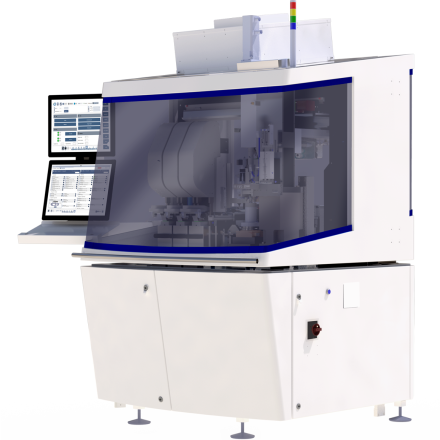
Assembly of a jewelry clasp
The assembly of jewelry clasps demands rigorous dimensional control and precise handling of precious metal components. The CIMOD AS.4 platform ensures high-precision automated micro-assembly, with systematic functional testing of every part produced.
Initial Situation
The assembly of a jewelry clasp on AS.4 involves components handled directly from bulk, requiring precise control of feeding and orientation.
The assembly consists of four components: the body, the trigger, the spring, and the pin, whose assembly must ensure perfect functionality.
Component orientation is essential to enable correct positioning and successful assembly.
A control of assembly and functionality is required to guarantee the conformity of each part.
Objective: achieving a 16-second cycle time, while meeting the quality standards of the jewelry industry.
Challenge
The lateral insertion of the spring and the trigger into the body represented a major technical challenge, requiring precision and controlled force application.
The handling of precious metal components required extreme care and flawless process reliability.
A 100% testing was essential to guarantee the functionality of each assembled clasp.
The feeding of springs from bulk added an additional constraint in terms of handling and positioning.

Why the AS.4 Platform ?
Precision
The AS.4 platform ensures a high level of precision and repeatability, essential for assembling escape wheel assemblies with micrometric tolerances.
Efficiency
Designed for industrial efficiency, it enables unattended night operation, ensuring continuous and secure productivity.
Flexibility
Its flexibility allows 10-minute changeovers, without compromising process stability.
Ergonomics
The machine’s ergonomic design facilitates daily operation, and the customer is fully autonomous in creating and adapting recipes for new production batches.n.
Proposed solution
A Modufeed with a dedicated purge system for springs ensures reliable and continuous feeding despite the complexity of the component.
A fixture with multiple drawers enables optimized organization of the assembly operations.
The orientation of the drawer before component placement ensures precise and repeatable positioning.
A testing station in hidden time validates functionality without impacting cycle time.
The assembled products are placed on alveolar trays, ensuring safe handling of finished parts.